


“I think we shared the same brain on this project.”
It’s his first score. When he started on it, he barely knew what a “cue” was, let alone what composing for a film really entailed. He didn’t have a ton of time to prove himself before the momentum took hold, but he did so to great effect. Obsession composer Rock Burwell has turned in an enthralling but carefully tempered complement to all of the artfully unhinged and delightfully nuanced on-screen performances of this major cultural touchstone.
If we think of box-office money as a decent indicator of interest, then people are, well, obsessed with the film. Writer-director Curry Barker and crew made the film for about $750,000, and so far it’s cleared about $380 million, according to Box Office Mojo. Even with its streaming availability, I wouldn’t be surprised to see the theatrical numbers increase. Nevertheless, a lot of awful films make a whole lot of money, so let’s put it out there: The film is fantastic and Burwell’s skilled use of melody, synthscapes, and soundcraft are a key to making the whole thing work. And it all flows from an authentic DIY mentality that comes from being an independent musician and producer — a perfect pairing for Barker, who’s earned his fame and respect through YouTube and not traditional channels.
The Barker-Burwell partnership began when the composer worked on a music video for Barker and eventually morphed into a dynamic in which the virtual neighbors in Los Angeles would work closely to fine-tune the tenderness and foreboding that bathes Obsession. Or, as Burwell put it to Vehlinggo recently: “I think we shared the same brain on this project.”
“… He was coming over for longer sessions to look over everything, because he was also editing the film at the same time in his bedroom down the street,” Burwell said . “We were very much doing this out of our homes.”
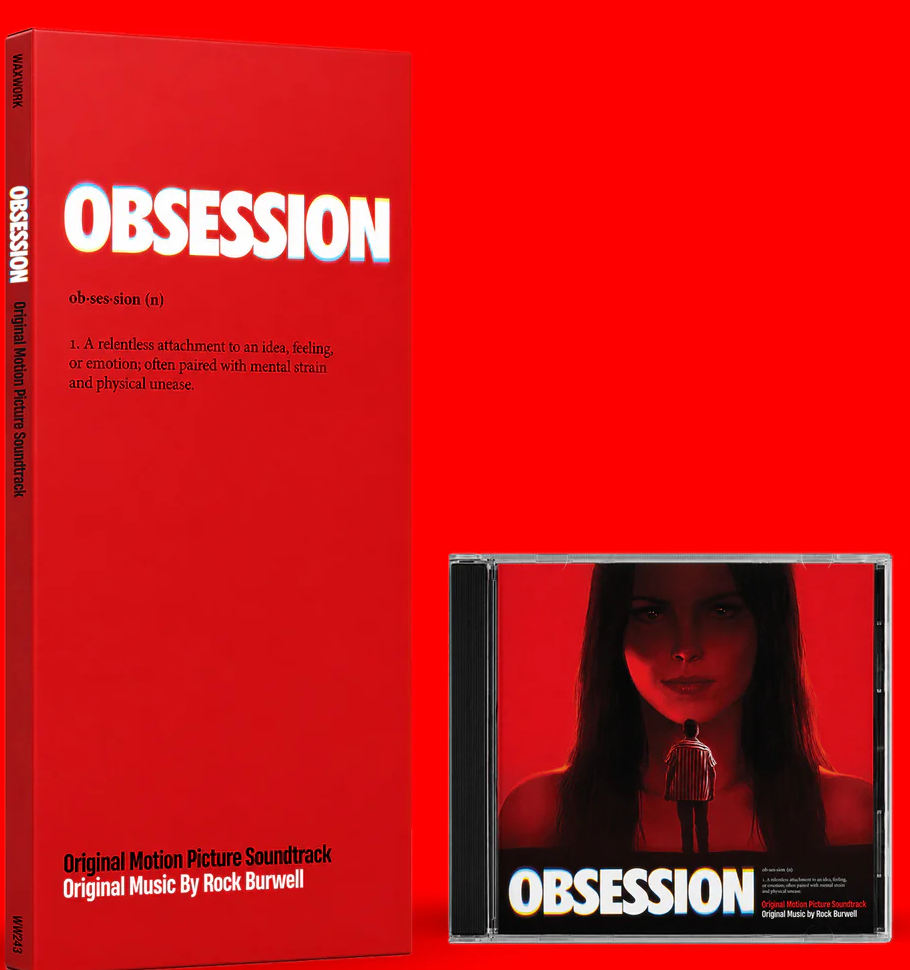
Amid an open pre-order for Waxwork Records’ and Back Lot Music’s physical media offerings of Burwell’s soundtrack album, I caught up with the New Hampshire-born composer over Zoom for an interview: he in his in-home studio in a converted garage in North Hollywood and I at Vehlinggo HQ in the Hudson Valley of New York. We covered a range of topics surrounding his score: its origins, his creative philosophy and relationship with Barker, the impact of the phenomenon on his life, what’s next for him, and of course Twin Peaks, among other things. (And no, he’s not related to the Coen Brothers’ go-to film composer, Carter Burwell.)

Vehlinggo: This is your first feature, which is wild to be striking gold like that right out the gate. From what I’ve read, your opportunity to score grew out of a project where you’d already met Curry Barker. Was scoring films something you’ve always wanted to do, while you were spending most of your time on production and other music work? Or did it only come up once you were working with him?
Rock Burwell: I definitely always had it as a potential option, an area to explore. To me it was a bit mysterious how you break into a world like that, but I was really into making little early YouTube videos as a kid. I liked the whole visual-media component — music and video together. A lot of my close friends out here [in LA] came from film school, so I’m kind of ingrained in their world. So yeah, it was some degree of a natural progression, except the progression happened incredibly quickly, in a single moment.
So lightning really did strike. When you met him, was it through his YouTube work?
My friend Harry J and I would co-produce artists — he’s a vocal coach and a great musician. That’s how we got connected to a friend of a friend, for That’s a Bad Idea, their sketch comedy. They wanted to produce a song for a comedy music video. It was literally during that time that Curry got green-lit for Obsession, and he just asked if I’d ever be into scoring.
And you were like, “Sure, why not?”
Yeah. My gut was like, “Don’t turn this down. Don’t say no to this; we’ve got to explore what this is.” I was familiar with his work, and working with him on that first project was awesome, so I really believed in everything he was doing. I had a gut instinct there was going to be something special here — but who could have seen what it turned into?
Describe your workspace for me. Some people score in a recording studio with a screen, some do it at home on a laptop, and so forth. How did you approach it, and how involved was Curry (and how much leeway did you get to create)?
To me it felt very run-and-gun, DIY, which I love — that’s what I’m used to with independent artists. I did everything in the room I’m sitting in, which is an [accessory dwelling unit] conversion of the garage out back. We joke and call it “the little shed.” Curry actually only lives about five minutes away, so pretty quickly we were going back and forth to each other’s places. He’d get 10 minutes of the initial edit and say, “Hey, I’ve got some stuff for you, can I come show you?” He’d drop me the hard drive, we’d look at it, [and] start breaking into some ideas. As it picked up, he was coming over a lot and I was going over there. The final few weeks really picked up — he was coming over for longer sessions to look over everything, because he was also editing the film at the same time in his bedroom down the street. We were very much doing this out of our homes.


That’s one of Obsession’s charms overall: It doesn’t feel like decision-by-committee to the point of being suffocated. But also of note, at least for Vehlinggo readers: The synth-dominant palette is something I’m always a sucker for — I’m a huge fan of Cliff Martinez and Clint Mansell. What got me, though, is that there are a lot of synth scores trying to do a John Carpenter thing — dark arps and so on — but you don’t just rest on that. Now, you do have dark passages where they’re needed, but you also gave the picture a lot of breathing room. It reminded me of [Angelo] Badalamenti — not totally in your face, complementing what’s going on, but utterly memorable — and it works on its own, too. Was that breathing room your decision or a product of [Barker’s] input?
It was definitely very collaborative… Once we got on the same page, I felt pretty confident in the decisions I was making. It was all very intentional; but a lot of it was also intuitive, not so cerebral and conscious. I was really doing my best to immerse myself in the performances and dive into those particular emotions — that line the characters are walking a lot of the time. The synth palette was something we discussed and had a clear vision on early, but it also worked out partly from what I had as tools — everything was “in the box.” I wish I’d had all the hardware and real vintage synths, but I did everything within virtual instruments for the most part — 90-plus percent of it.
I love that you brought up Angelo, because that’s probably my number one inspiration. Twin Peaks is forever ingrained in me, emotionally and sonically, and I think those things are always going to shine through. It just so happened this was the perfect project to explore those sounds and ideas and emotions, so it landed right in my wheelhouse. I do a lot of my own experimentation with ambient synth music, but I don’t have a long history of leading with that or releasing that type of music. So it’s been really cool to connect with artists I’ve been familiar with in the genre for years who are respecting my work as such a newcomer to the space.
“Twin Peaks is forever ingrained in me, emotionally and sonically…”
In the Waxwork promo materials you mentioned experimenting with claustrophobia, and the juxtaposition of warmth and dread. That stuck with me, because to me it felt like such an open score. What was claustrophobic about it to you; maybe the visuals?
I think it’s a mixture. The way the film was shot and lit, it felt like you were trapped in a box. The emotions were so driving to me that the claustrophobic feeling was something I wanted to tap into. Some of the pads and synths feel very expansive, but at the same time they could almost be a lead blanket washing over you, enveloping you — very warm, very dark. There’s not a lot of brightness; we cut off so many of the highs.
Right. If we get a little literal, Bear (Michael Johnston) is claustrophobic because he gets his wish in the worst way possible, and Nikki (Inde Navarrette) is claustrophobic because her soul is trapped as if she’s in her own sunken place. I wonder if I’ve been trained to think of warmth as this arms-wide-open, milk-and-honey thing, but if you cut off the high end it gets that warm-tape feel.
Definitely. We were working with that juxtaposition of both simultaneously. I think some of the magic was not doubling down on one thing — allowing both to exist at once, which gave an interesting feel. Curry said something early on that I don’t want to misquote, but it was almost to think of the score, and the emotions specifically, as a romance film disguised as a horror film. I thought that was interesting — not to approach it overtly horrific, but to explore the more tender, personal emotions first and then warp them into horrific things.
I have the word “tender” in my notes four times. There are cues that are just genuinely tender and gentle.
You were watching these scenes over and over, getting to know the characters. Were there any who stuck out as ones you really liked scoring to?
I’m not sure I ever consciously thought of it like that, but Nikki and Bear together — their dynamic, their relationship almost fused into its own character — was probably the inspiring thing. It was easy to score their performances. I felt them as very visceral and impactful, so the more emotional, heated moments actually came easiest to me. Some of the more abstract, weirder situations were more daunting. Honestly, the whole thing was pretty abstract — I really just trusted intuition. The end process, scoring the last two-and-a-half weeks to picture-lock, was so intense I almost feel like I blacked out. I entered a flow state for two weeks straight. So when I recall the details now, sometimes I’m exploring subconscious things I wasn’t even aware of.
“I entered a flow state for two weeks straight.”
I can see how that happens. Somewhat related to that intensity: In our local movie theater, people were so engaged you could’ve thrown a popcorn container at them and they wouldn’t have noticed — no phones out, no chatter, nothing. You don’t see that a lot anymore.
It’s pretty wild. I’ve had a few moments where it hit me. My girlfriend and I have gone to see it a few more times, more as a fly on the wall. One time we showed up late, a few minutes before a screening, and I remember rounding the corner and seeing every single seat full. It was a feeling I don’t know if I’d seen in a theater since I was a kid — the chatter during the previews, and then that bit of stillness where you know it’s about to begin, and it got so dead silent in there. I haven’t felt an audience so tapped in, so ready to experience something, in a long time. It’s hit me pretty hard a few times, in a great way.
It’s a throwback, too. Curry comes from a newer media style — YouTube, what’s on your phone, etc. — and what you’re describing is cinema as the main event, the way it used to be. Hell, when I was a kid, we’d wait a year or more just to rent a VHS to watch a film at home.
I’m part of that last little group that grew up with the internet as it grew up, in the late ’90s, and pretty soon phones just became universal. Every major event you go to now, everyone has their phone out. Obsession has brought people to the theaters — younger people, especially — and brought them more into the present moment, to experience art in a form of media where it’s not a sea of phones filming a concert. That’s incredible.
Is trusting your gut something you bring to everything, not just music?
Yeah, I’d say so. That’s the biggest thing that’s carried me through this career — putting trust and faith in something bigger than me. A meditation practice was huge for managing how overwhelming the process got toward the end, but also for grounding and tapping into something greater to lead the decisions intuitively.
There’s a decent amount of imposter syndrome we all deal with, especially on a first feature like this. Going into the film, I didn’t even know a lot of the technical terms — I didn’t even know a cue was called a “cue.” There were so many basic things I was frantically scouring the internet for, just so I could speak the language, never mind properly exporting the whole score into stems. Everything was so new and intimidating, but the challenge was exciting, and I never want to look a big challenge in the face and walk away.
With how serendipitously it fell into my lap, it felt very aligned. So I trusted that every decision was how it was supposed to be. There were a lot of decisions I’d go back and forth on afterward, analyzing whether it was the right idea, and I just ultimately trusted it — and I guess it worked.
Is there a cue that’s your favorite — one where, every time you hear it, you think, “I really nailed that”?
I’m pulling it up myself, because I’m always looking at the soundtrack now. The “Hansel and Gretel” monologue is one of my personal favorites — it’s parallel to the “Are You OK” cue right after the wish is made, that same unnerving synth sound. There’s something in the Hansel monologue in particular, this twisting, almost like thorny vines, with some rumbling monster within it. I just love how that one came together.
And “Into Darkness”… was one of the later ones I did, where I felt like I really clicked in. I was confident in my approach at that point. I love it as a song in general, and I see it connecting with people.
There are so many I think of very dearly. They’re my children.
“Love is in the Air, Pt. 1” was one of the first made that me think of Twin Peaks and Badalamenti. It’s dreamy, airy, never in your face, but poignant.
“Love is in the Air, Pt. 2” was actually created first. It was the very first thing I did, period. It was right after I read the script, before I’d officially gotten the job, and it served as my audition to the producers.
Curry wanted me to compose the film, but he said, “They need something, because you don’t have a portfolio and they’re just trusting my word.” He asked if I could make some stuff, and when I asked when he needed it, he said, “Tomorrow.” This was around 10 p.m., so I went out to the studio, and that’s when “Love is in the Air, Pt. 2” was made.
I felt so connected to that piece. I always prayed it would make it into the film, and when I got Curry’s edit and saw he’d put it in as the finale, it got me emotional — this was all meant to be. We ultimately repurposed that theme for the main love montage in the middle of the film and reworked it with drums. That’s the only time I actually recorded live instruments on this whole thing: the guitar and the drums.
Let’s jump to talking about the soundtrack album, which Waxwork Records and Back Lot Music are offering in very cool vinyl, cassette, and CD formats. The album is sequenced with a seemingly specific intent for the physical releases. You can’t fit everything on a release, especially on vinyl, given the medium’s space constraints.
That’s ultimately why it had to be cut down: They said 44 minutes, 22 a side, is kind of the limit for vinyl. I think I submitted an hour and nine minutes of score, so there’s a lot of it. Some people say they wish it were more pronounced, and I’ve seen comments on the other side that it’s too much at times. I love that art is subjective.
What’s next for you?
I’m working on the next score actively right now, starting on early ideas for Curry’s next film, Anything But Ghosts. Hopefully it’ll be a similar process — he’s [currently] editing [the film], but we need to catch up. We haven’t been able to since everything changed… I’m excited for what the future holds.
[This interview has been edited and condensed for clarity and length.]
